16 OCT 2024
Academic Scholars Sessions – Year 10 & 11 - Medieval Literature
Engaging sessions to stretch our more able students with extension activities.
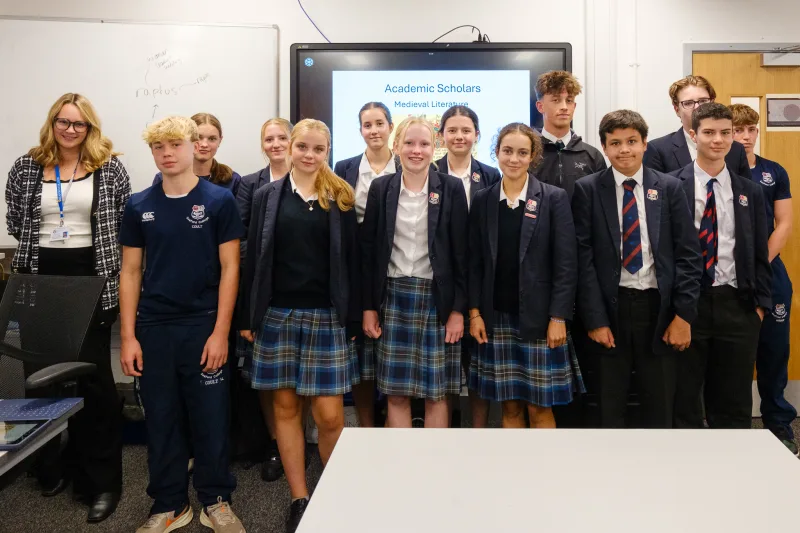
Emma Low, English Teacher and Cambridge graduate has started her new role as Academic Scholars and Oxbridge Co-ordinator to lead the Scholars Programme. Emma’s Year 10 & 11 fortnightly mini lectures for the first half term continued with a look at Medieval Literature. Emma said: “Students are unlikely to come across medieval literature at GCSE level; I was introduced to it for the first time at university. We’re looking at it today because I think there’s interesting things in it.”
Emma spoke about what it was like to live in Medieval England (500 years ago) and then posed the question, ‘With this in mind, what would you expect the literature of the time to be about?’. The class gave some good answers and suggested that religion would have been a key component. Emma expanded on their ideas and explained that religion was a feature, but some literature included unexpected elements such as fart jokes, plans going wrong and idiotic husbands.
Emma introduced The Canterbury Tales to the group with a video and then focused on The Miller’s Tale by Geoffrey Chaucer, she explained that the story contains slapstick humour. The class looked at a passage in Middle English and worked in pairs to translate the story.
Emma explained that there was no standardised spelling in this period and that the Middle English text is more challenging than Shakespeare's language.
They then worked in pairs to discuss various aspects of the story; What is Chaucer trying to tell us about love? What is surprising about Chaucer’s depiction of Alisoun? If Chaucer’s Miler told a tale like this, what kind of tale would you expect the Knight to tell? What about the nun? What does Chaucer’s use of humour tell you about the Middle Ages? What does it tell you about humour in general? Do you blame Alisoun for wanting to be with someone her own age? What does arranged marriage lead to?
They then looked at what happened that was scandalous in Chaucer’s life and the evidence for the scandal. Emma explained that the word ‘raptus’ can mean rape and a women leaving her husband and running away. She said: “If he was a rapist, should we still read his works? Would it be appropriate – can you separate the artist from the art? It's an interesting moral conundrum.”
At the end of the session Emma said: “I was really impressed with how well they translated the Middle English text. The class picked up on Alisoun’s immaturity for her age and discussed how love can’t be forced as well as discussing the themes of free will and consent in his writing. They had very mature and perceptive thoughts in their discussions.”
Thank you, Emma, for organising an engaging and interactive session that has got us all thinking about Geoffrey Chaucer’s work.